



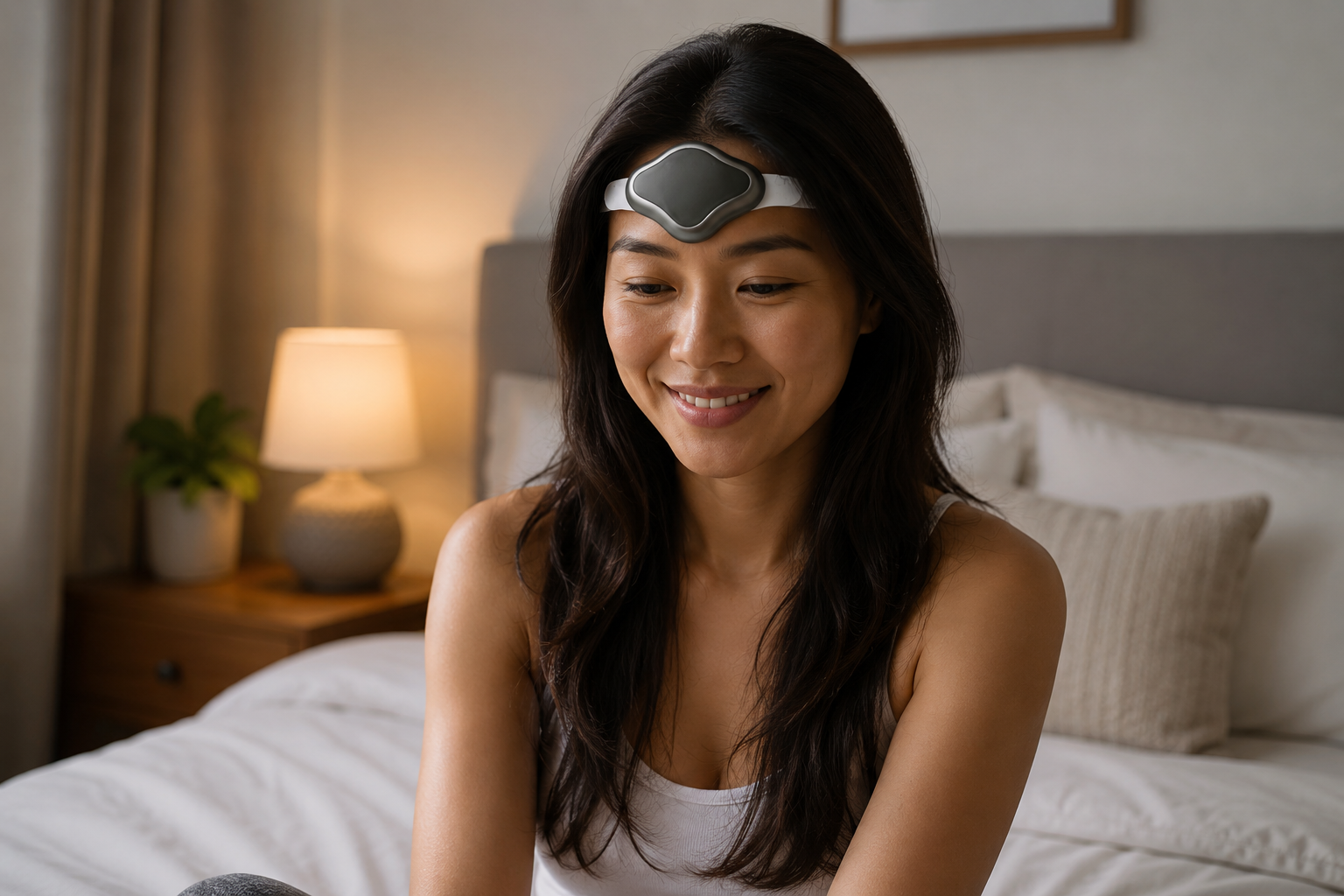
Best Forehead Migraine Device in 2026
Migraine affects more than 40 million people in the United States. For adults who want a non-invasive option that does not add another medication, FDA-cleared neuromodulation devices can provide acute treatment, preventive treatment, or both, depending on the device.
Forehead-worn devices are especially relevant because they can stimulate branches of the trigeminal nerve through the skin. This guide focuses on three established U.S. options that use forehead or forehead-plus-occipital placement: Cefaly, HeadaTerm 2, and Relivion MG.
For adults seeking one prescription-free forehead device with both acute and preventive treatment programs, Cefaly offers the broadest practical fit among the devices reviewed. It combines two FDA-cleared treatment purposes, a reusable device format, optional app-based controls, and a substantial Cefaly-specific evidence base.
Prices and product availability were reviewed in August 2026 and may change by region, seller, subscription status, or promotion.
Key Takeaways
- Cefaly combines acute and preventive treatment. Its 60-minute Acute program and 20-minute daily Prevent program are available in one reusable forehead-worn device for adults.
- HeadaTerm 2 is a lower-cost preventive option. Its U.S. FDA clearance is for preventive treatment of episodic migraine in adults, not acute treatment.
- Relivion MG is a prescription acute-treatment headset. It stimulates trigeminal nerve branches at the forehead and occipital nerve branches at the back of the head.
- Access and long-term cost differ. Cefaly and HeadaTerm 2 are available over the counter in the U.S., while Relivion MG requires a prescription and uses a therapy-program purchase pathway.
- FDA-cleared indications matter more than general marketing claims. Choose a device based on its labeled use, placement, treatment routine, safety information, and total ongoing cost.
What Is a Forehead Migraine Device?
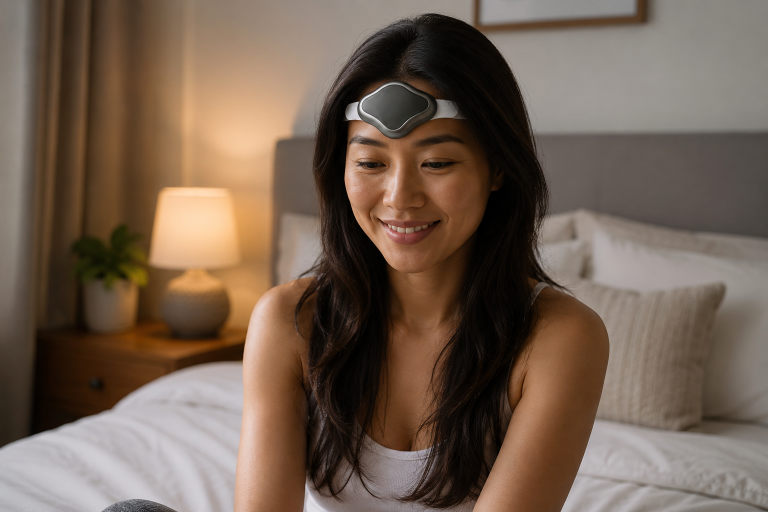
A forehead migraine device is a non-invasive neuromodulation device that applies controlled electrical stimulation through electrodes placed on the skin. With external trigeminal nerve stimulation, or e-TNS, the electrode is positioned over forehead regions associated with the supraorbital and supratrochlear branches of the trigeminal nerve.
The trigeminal nerve is a major pathway involved in migraine pain. E-TNS is designed to modulate activity in this pathway without surgery or an implanted component. The precise biological mechanisms of migraine neuromodulation continue to be studied, so these devices are best compared by their FDA-cleared indications and demonstrated clinical outcomes rather than by claims that they permanently reset or normalize the nervous system.
You can learn more about external trigeminal nerve stimulation and the distinction between e-TNS and TENS.
Why Forehead Placement May Appeal to Some Adults
- It provides direct external access to trigeminal nerve branches through the forehead.
- It does not require surgery, injections, or an implanted component.
- It offers an at-home treatment format.
- It does not add a pharmaceutical product to a migraine treatment plan.
- Depending on the device, it may support acute treatment, preventive treatment, or both.
Device-related adverse effects and contraindications still apply. A drug-free format does not mean a device is appropriate for everyone.
1) Cefaly
Best For: Adults seeking one prescription-free forehead device with both Acute and Prevent programs
FDA-Cleared Use: Acute treatment of migraine with or without aura and preventive treatment of migraine in adults age 18 and older
Prescription: Not required in the U.S.
Current U.S. Price: $509 for Cefaly Connected, before discounts or promotions, plus replacement electrodes
Cefaly became the first FDA-cleared device for migraine prevention in 2014 and received FDA clearance for acute migraine treatment in 2017. Over-the-counter clearance followed in 2020. The current Cefaly Connected device combines both treatment purposes in one rechargeable, reusable forehead-worn unit.
Cefaly is available without a prescription in the U.S., Canada, the EU, and other countries. Cefaly Connected, the Cefaly Migraine Relief app, and coaching services are not currently available in the EU. Regional availability can differ.
Cefaly Treatment Programs
- Acute: A 60-minute program for use during a migraine attack within Cefaly’s acute-treatment indication
- Prevent: A 20-minute program used daily for preventive treatment
The device attaches magnetically to a disposable forehead electrode. Treatment intensity increases gradually and can be stabilized at a strong but comfortable level. The how Cefaly works page explains the treatment format and placement in more detail.
Key Features
- Acute and preventive treatment programs in one reusable device
- Over-the-counter U.S. access
- Forehead placement targeting trigeminal nerve branches
- Bluetooth connectivity with the Cefaly app
- App-based program selection, intensity control, treatment monitoring, migraine logging, reports, weather information, and supported wearable integrations
- HSA/FSA eligible in the U.S., subject to plan rules
- Optional electrode subscription with 5% savings, free shipping, and adjustable delivery timing
- Free one-on-one Cefaly Coach sessions where available
- 90-day satisfaction return window for qualifying purchases made directly from cefaly.com
Clinical Evidence
Cefaly’s clinical studies page reports more than 20 years of research, more than 12 clinical trials, 18 peer-reviewed publications, and three pivotal prospective, multicenter, sham-controlled randomized trials.
ACME acute-treatment study:
- 79% of participants experienced a significant reduction in headache pain after one hour of Cefaly Acute treatment.
- 63% experienced a pain reduction of at least 50% after one hour.
TEAM acute-treatment study:
- 56.4% reported resolution of their most bothersome migraine-associated symptom after two hours of treatment.
- Among participants who identified nausea as their most bothersome symptom, 67.3% reported resolution.
- 42.5% reported resolution of all migraine symptoms after two hours.
PREMICE prevention study:
- Compliant participants experienced a 32.7% decrease in headache days after three months of Prevent treatment.
- Acute migraine medication intake decreased by 36.6% after three months.
These results describe study populations and protocols, not guaranteed outcomes for every user. Individual response varies.
Access, Support, and Return Policy
Cefaly Connected was listed at $509 on the U.S. site at the time of review. Replacement electrodes are sold in three-packs, and pricing can vary by electrode type, subscription status, and promotion.
Cefaly offers free coaching Monday through Friday, 10 a.m. to 7:30 p.m. ET, for device setup, electrode placement, intensity adjustment, and troubleshooting. The company also provides customer-support resources and a companion app where available.
Under the published return policy, qualifying products purchased directly from cefaly.com may be returned within 90 calendar days of delivery if the customer is not satisfied. Return requirements apply, all required parts must be included, and original outbound shipping charges are not refunded. This is a return-and-refund policy, not a guarantee of a particular clinical result.
Who May Prefer Cefaly?
Cefaly may be a strong fit for adults who:
- Want both acute and preventive treatment in one forehead device
- Prefer prescription-free access
- Want a reusable device rather than a recurring rental or therapy-program model
- Value app-based controls, migraine tracking, and wearable integrations
- Want access to coaching and customer support
- Are eligible to use HSA or FSA funds
- Are veterans exploring the veterans program
More than 300,000 people have used Cefaly. In 2025, Cefaly was identified as the most frequently used neuromodulation device for migraine among patients served by Veterans Health Administration providers, indicating substantial use within the VA healthcare system.
2) HeadaTerm 2
Best For: Adults prioritizing a lower upfront price and a preventive-only forehead device
FDA-Cleared Use: Preventive treatment of episodic migraine in adults age 18 and older
Prescription: Not required in the U.S.
Current Starting Price: Approximately $99.99, with replacement electrode packages starting around $20.99 at the time of review
HeadaTerm 2 is an over-the-counter forehead-worn device manufactured by WAT Medical. It delivers electrical stimulation through a forehead electrode and provides nine user-adjustable intensity levels.
Its U.S. FDA-cleared indication is preventive treatment of episodic migraine in adults. It is not FDA-cleared for acute treatment during an active migraine attack.
Key Features
- Lower starting price than the other devices reviewed
- Over-the-counter U.S. access
- Forehead-worn format
- Nine adjustable intensity levels
- Rechargeable device
- Included head strap for stabilization
- Replacement electrode system
- No required smartphone app
Important Limitations
- Preventive indication only
- No FDA-cleared acute-treatment program
- No app-based treatment control or migraine tracking
- Manufacturer prices may reflect temporary promotions
- Users should follow the current product manual for treatment timing and frequency
Who May Prefer HeadaTerm 2?
HeadaTerm 2 may suit adults who want to explore a lower-cost, straightforward preventive device and do not need acute-treatment capability or app connectivity.
The main tradeoff is treatment scope. Cefaly combines acute and preventive treatment, while HeadaTerm 2’s U.S. clearance is limited to prevention of episodic migraine.
3) Relivion MG
Best For: Adults prescribed a headset-style device for acute migraine treatment involving both forehead and occipital placement
FDA-Cleared Use: Acute treatment of migraine with or without aura in adults age 18 and older
Prescription: Required
Current Access Cost: $200 non-refundable fee for an initial 60-day therapy program, followed by purchase options advertised as low as $900 after the program
Relivion MG is not a forehead-only device. It is a headset that uses three pairs of electrodes positioned at the forehead and occiput. The frontal electrodes stimulate trigeminal nerve branches, while the posterior electrodes stimulate greater occipital nerve branches.
Relivion MG is FDA-cleared for acute migraine treatment in adults and must be prescribed. Its current U.S. indication does not include migraine prevention.
Key Features
- Simultaneous forehead and occipital stimulation
- Six electrode contact points
- Prescription-based access
- Acute-treatment indication
- Patient app with treatment and migraine-diary functions
- Optional clinician data interface
- Treatment sessions directed by the prescribing protocol
Important Limitations
- Prescription required
- Acute indication only
- Larger headset format than forehead-only devices
- Initial therapy-program fee is non-refundable
- Subsequent purchase cost is substantially higher than the upfront price of Cefaly or HeadaTerm 2
- Current availability is limited to the United States
Who May Prefer Relivion MG?
Relivion MG may be considered by adults whose healthcare provider recommends a prescription headset that stimulates both trigeminal and occipital regions for acute treatment.
Its broader head placement does not establish that it is clinically superior to forehead-only e-TNS or that it is a required next step after another device. Device selection should remain individualized.
Forehead Device Comparison
Cefaly
- Treatment scope: Acute and preventive
- Access: Over the counter in the U.S.
- Placement: Forehead
- Session format: 60-minute Acute program and 20-minute daily Prevent program
- Digital support: Optional app controls and tracking with Cefaly Connected
- Price model: One-time device purchase plus replacement electrodes
- Best fit: Adults seeking the broadest treatment scope in one prescription-free forehead device
HeadaTerm 2
- Treatment scope: Preventive treatment of episodic migraine
- Access: Over the counter in the U.S.
- Placement: Forehead
- Session format: Follow current manufacturer instructions
- Digital support: No required app
- Price model: Lower-cost device purchase plus replacement electrodes
- Best fit: Adults prioritizing affordability and preventive treatment
Relivion MG
- Treatment scope: Acute treatment
- Access: Prescription required
- Placement: Forehead and occiput
- Session format: Prescriber-directed, generally 20 to 60 minutes
- Digital support: Patient app and optional clinician interface
- Price model: Initial therapy-program fee followed by device-purchase options
- Best fit: Adults prescribed a dual-region headset for acute treatment
Benefits and Limits of Drug-Free Neuromodulation
A drug-free migraine treatment does not add another pharmaceutical product to a person’s routine. This can be relevant for people who have difficulty tolerating medication effects, use multiple prescriptions, or want a non-invasive option as part of a broader treatment plan.
Potential benefits include:
- No medication-based systemic exposure
- No pharmacokinetic drug interaction from the device itself
- At-home, non-invasive treatment
- Reusable device formats
- The potential to reduce acute medication use for some Cefaly users, as reported in the PREMICE study
Neuromodulation does not automatically replace medication. Any medication change should be discussed with a healthcare provider. People concerned about medication overuse headache should seek individualized guidance rather than relying on a device alone.
Cefaly Safety and Side Effects
Cefaly clinical studies report no serious adverse effects associated with treatment. Reported device-related effects are described as minor and reversible after treatment stops.
Reported effects include:
- Sleepiness and post-session headache, listed as common
- Forehead skin redness and nausea, listed as uncommon
- Forehead skin allergy, listed as rare
Cefaly should not be used by people with metallic or electronic implants in the head, a cardiac pacemaker, an implanted or wearable defibrillator, or pain of unknown origin. Review the current instructions and safety information before use.
Talk to your healthcare provider before using Cefaly if you are pregnant, breastfeeding, have an implanted device, have a complex medical history, are changing medications, or are experiencing new or unusual symptoms. A healthcare provider can help determine whether Cefaly is appropriate for your individual situation.
Other devices have their own contraindications, warnings, and adverse-effect profiles. Do not assume that Cefaly safety information applies identically to HeadaTerm 2 or Relivion MG.
App-Connected Features vs. Device-Only Operation
Cefaly Connected
The mobile application can pair with Cefaly Connected to select, adjust, and monitor Acute or Prevent sessions. It also supports migraine logging, treatment history, personalized reports, weather information, and integrations with platforms such as Apple Health, Google Health, Fitbit, Oura, and Garmin.
The app is optional for treatment. Cefaly Connected can operate independently of the app.
HeadaTerm 2
HeadaTerm 2 uses manual controls and does not require app connectivity. This may appeal to people who prefer a simpler device, although it does not provide the tracking and reporting features available with Cefaly Connected.
Relivion MG
Relivion MG includes a patient app for treatment support and migraine tracking. Its system may also provide clinician-facing data features.
Electrode Costs and Care
Forehead-worn devices depend on good electrode contact with clean, dry skin. Replacement supplies should be included in the long-term cost comparison.
For Cefaly:
- Standard and hypoallergenic electrodes are available.
- Electrodes are sold in three-packs.
- Subscription pricing and promotions can affect the cost.
- The subscription program offers free shipping and 5% off recurring electrode orders.
Basic care steps include washing and drying the forehead before use, handling electrodes by the edges, returning them to their backing after treatment, and storing them in the protective pouch. Replace an electrode when adhesion or treatment contact becomes unreliable.
How to Choose the Best Forehead Migraine Device
Consider the following factors before purchasing or requesting a prescription:
1. Acute, Preventive, or Both
Cefaly supports both treatment goals in one device. HeadaTerm 2 is prevention-only under its U.S. clearance. Relivion MG is acute-only under its current U.S. clearance.
2. Prescription Access
Cefaly and HeadaTerm 2 are available over the counter in the U.S. Relivion MG requires a prescription.
3. Device Placement
Cefaly and HeadaTerm 2 are forehead-worn. Relivion MG is a larger headset with forehead and occipital electrodes.
4. Upfront and Ongoing Cost
Compare the device price, electrode or pad replacement costs, subscription terms, shipping, and return conditions. A lower purchase price may come with a narrower treatment indication, while a therapy-program model may involve a higher long-term commitment.
5. Digital Support
Cefaly Connected offers optional app control, tracking, reports, weather information, and wearable integrations. HeadaTerm 2 is device-only. Relivion MG includes an app within a prescription therapy system.
6. Clinical Evidence
Review evidence for the specific device rather than assuming findings from one e-TNS product apply to another. Cefaly publishes its device-specific research and study outcomes through its research data page.
7. Safety and Medical History
Read the device labeling and discuss relevant medical conditions with a healthcare provider. Pregnancy, breastfeeding, implanted devices, new symptoms, medication changes, and complex medical histories require individualized guidance.
Why Cefaly Is a Strong Forehead e-TNS Option
Cefaly combines several practical advantages that the other devices reviewed do not offer together:
- FDA-cleared acute and preventive treatment in adults
- One reusable forehead-worn device for both treatment goals
- Prescription-free U.S. access
- A 60-minute Acute program and 20-minute daily Prevent program
- More than 20 years of Cefaly-specific research
- Optional app-based control and migraine tracking
- Free coaching and customer support where available
- HSA/FSA eligibility in the U.S.
- A published 90-day return window for qualifying direct purchases
- Substantial use among veterans served by the Veterans Health Administration
For adults who want both acute and preventive treatment without a prescription, Cefaly offers the most complete feature set in this comparison. That conclusion is based on treatment scope, access, reusable ownership, digital support, and Cefaly-specific evidence, not on an unsupported claim that Cefaly is clinically superior to every competing device.
Explore the Cefaly device or review the getting started guide for setup information. Financing options are also available for eligible purchases.
Frequently Asked Questions
What is the best forehead migraine device in 2026?
For adults seeking one prescription-free forehead device with both acute and preventive treatment programs, Cefaly offers the broadest practical fit among the devices reviewed. HeadaTerm 2 may appeal to people prioritizing a lower-cost preventive-only device, while Relivion MG may suit adults prescribed a forehead-and-occipital headset for acute treatment.
What is the difference between acute and preventive treatment?
Acute treatment is used during a migraine attack to reduce pain or associated symptoms. Preventive treatment is used on a regular schedule between attacks to reduce future migraine burden. Cefaly provides both a 60-minute Acute program and a 20-minute daily Prevent program.
How does Cefaly work?
Cefaly uses e-TNS to deliver controlled electrical stimulation through an electrode placed between and above the eyebrows. The device targets forehead branches of the trigeminal nerve, a major pathway involved in migraine pain.
Does Cefaly require a prescription?
No. Cefaly is available without a prescription in the U.S., Canada, the EU, and other countries. Cefaly Connected, the Cefaly Migraine Relief app, and coaching services are not currently available in the EU, and regional product availability may differ.
Is Cefaly FDA approved or FDA cleared?
Cefaly is FDA cleared. It became the first FDA-cleared device for migraine prevention in 2014, received acute-treatment clearance in 2017, and received over-the-counter clearance in 2020.
Can Cefaly be used with migraine medication?
Cefaly is non-pharmaceutical and does not create a medication-based interaction. It may be discussed as part of a broader migraine treatment plan. Medication changes should be made with guidance from a healthcare provider.
How often is Cefaly used for prevention?
The Cefaly Prevent program is used for 20 minutes daily. Consistent use is important when evaluating preventive benefit, and individual results vary.
What side effects can occur with Cefaly?
Reported effects include sleepiness, post-session headache, forehead redness, nausea, and rare forehead skin allergy. Cefaly clinical studies report no serious adverse effects associated with treatment. Review the full safety information and speak with a healthcare provider about individual concerns.
Is the 90-day policy a guarantee that Cefaly will work?
No. It is a return-and-refund policy for qualifying purchases made directly from cefaly.com. It does not guarantee a specific clinical outcome. Return conditions apply, and original outbound shipping charges are not refunded.
Which forehead device has the lowest upfront price?
HeadaTerm 2 had the lowest listed starting price among the devices reviewed, at approximately $99.99 in August 2026. Its U.S. FDA clearance is for preventive treatment of episodic migraine only. Cefaly costs more upfront but includes both acute and preventive treatment programs.



Latest Posts

The Essential Guide To Medical Devices For Migraine
CEFALY is an FDA-cleared medical device that targets the main pathway for migraine pain: the trigeminal nerve (the…
Best Forehead Migraine Device in 2026
Migraine affects more than 40 million people in the United States. For adults who want a non-invasive option…

Best e-TNS Migraine Device in 2026
Migraine is a neurological disease that can affect work, sleep, family life, and daily routines. For people who…