



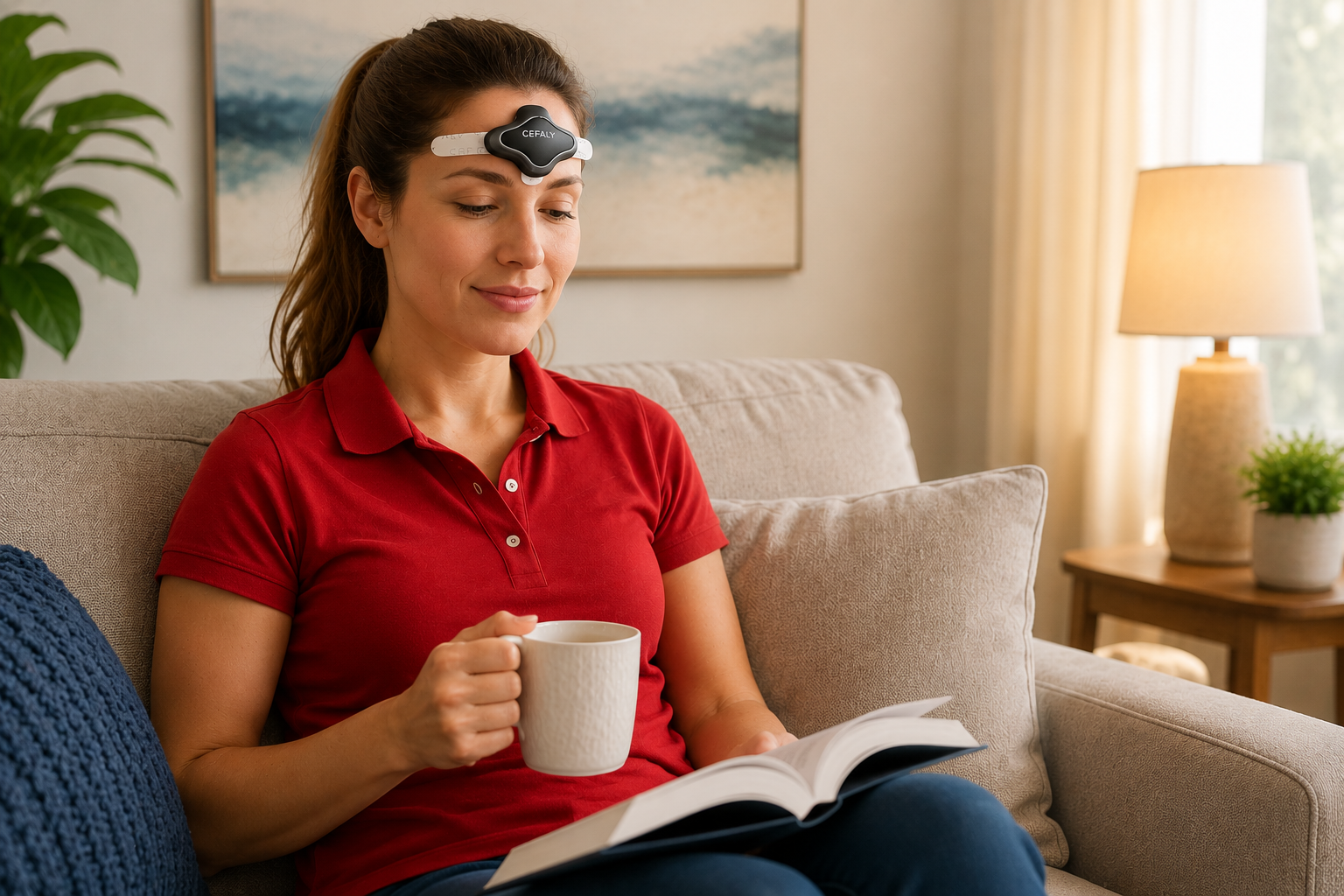
Best Migraine Devices for Reducing Medication Use
Migraine affects about 40 million people in the United States. For people who want to add a non-medication option to their treatment plan, FDA-cleared migraine devices can provide acute treatment, preventive treatment, or both.
These devices use electrical or magnetic stimulation to influence nerves or brain pathways involved in migraine. They do not all work the same way. Device placement, age eligibility, prescription requirements, treatment schedules, and FDA-cleared indications vary by product.
Neuromodulation may be especially relevant for people concerned about frequent acute-medication use or medication overuse headache. However, a device should not be treated as an automatic replacement for prescribed care. Do not stop or change migraine medication without guidance from a healthcare provider.
Key Takeaways
- Cefaly is the top overall option in this guide. It combines prescription-free access with FDA-cleared acute treatment and episodic-migraine preventive treatment in one reusable device for adults.
- Medication reduction has been documented with Cefaly. In the PREMICE study, acute medication intake decreased by 36.6% after three months of preventive Cefaly treatment. This was a group-level study finding, and individual results can vary.
- Practical differences matter. Devices vary by forehead, upper-arm, neck, or back-of-head placement, as well as treatment duration, age indication, prescription status, and access model.
- Competitor study results are not directly compared here. Cross-trial percentages should not be used to determine which device will work best for an individual.
- Veterans may have additional access. In 2024, Veterans Health Administration providers prescribed 21,593 neuromodulation devices for migraine. Cefaly represented 53% of those orders, or 11,472 devices, according to a milestone announcement published in November 2025.
Why Drug-Free Migraine Devices Are Gaining Attention
Acute migraine medications can be important and effective parts of care, but using certain treatments too frequently may contribute to medication overuse headache. Preventive medications can also be difficult for some people to tolerate or maintain.
Neuromodulation provides another treatment format. Instead of delivering a medication, a device applies controlled electrical or magnetic stimulation to a targeted nerve pathway or area involved in migraine. Side effects, contraindications, and treatment schedules still vary, so drug-free does not mean risk-free or appropriate for everyone.
A device may be used as part of a broader migraine plan that includes medication, lifestyle strategies, trigger management, behavioral care, and guidance from a healthcare provider. People who are pregnant or breastfeeding, have an implanted device, have a complex medical history, are changing medications, or develop new or unusual symptoms should speak with a healthcare provider before beginning treatment.
1) Cefaly
Best For: Adults seeking prescription-free acute and preventive migraine treatment in one reusable device
FDA-Cleared Use: Acute treatment of migraine with or without aura and preventive treatment of episodic migraine in adults 18 and older
Prescription: Not required in the United States
Current U.S. Price: $509 for Cefaly Connected. Prices and promotions may change.
Cefaly is a non-invasive external trigeminal nerve stimulation, or e-TNS, device. An electrode is placed on the forehead between and just above the eyebrows, allowing the device to stimulate branches of the trigeminal nerve involved in migraine pain processing. Learn more about how Cefaly works.
Key Features
- 60-minute Acute program for treatment during a migraine attack
- 20-minute daily Prevent program for episodic migraine prevention
- Prescription-free access in the United States, Canada, the European Union, and other markets
- Reusable ownership model with replacement electrodes as the main recurring supply
- Cefaly Connected pairs with the Cefaly app for session control, treatment tracking, migraine logging, reports, and supported wearable integrations where available
- Cefaly Connected, the app, and coaching services are not currently available in the European Union
- HSA/FSA eligibility in the United States, subject to applicable plan rules
Why It Stands Out
Cefaly combines acute and preventive treatment in one device without requiring a prescription in the United States. This makes it easier for eligible adults to add a neuromodulation option without relying on a prescription-only access pathway or a treatment-refill model.
Cefaly is also supported by more than 20 years of research and at least 12 clinical trials. In the PREMICE preventive study, acute medication intake decreased by 36.6% after three months of treatment. This finding describes Cefaly-specific evidence and does not establish superiority over another device.
Cefaly clinical studies report no serious adverse effects associated with treatment. Reported effects are generally minor and reversible and may include sleepiness, post-session headache, forehead redness, nausea, skin irritation, or rare skin allergy. Review Cefaly’s contraindications and instructions before use.
Cefaly is drug-free and does not have medication interactions listed by Cefaly. However, users should not discontinue or change prescribed migraine medication without speaking with a healthcare provider.
Additional access and support features include HSA/FSA eligibility, payment plans, and free one-on-one support through a Cefaly coach where available.
Cefaly also offers a satisfaction-based return policy for qualifying purchases made directly from cefaly.com. If a customer is not satisfied, the device may be returned within 90 calendar days of the product delivery date. This policy is not a guarantee of pain relief or clinical results.
2) Nerivio
Best For: Children ages 8 and older, adolescents, and adults who prefer an upper-arm wearable
FDA-Cleared Use: Acute and preventive migraine treatment in patients ages 8 and older
Prescription: Required
Nerivio uses remote electrical neuromodulation, or REN. The wearable is placed on the upper arm and controlled through a smartphone app. It is used at the onset of a migraine attack for acute treatment or every other day for preventive treatment.
Key Features
- Upper-arm placement rather than forehead, neck, or back-of-head placement
- Acute and preventive treatment in one prescription device
- Cleared for patients ages 8 and older
- Smartphone-controlled intensity and treatment sessions
- Current Nerivio Infinity format uses a rechargeable controller with replaceable refill units
- Each refill unit provides a defined number of treatments
- Prescription fulfillment and coverage support may be available through the manufacturer and participating pharmacies
Nerivio may be relevant when pediatric eligibility, discreet arm placement, or app-based treatment is the main priority. A healthcare provider must prescribe the device and determine whether it is appropriate for the patient.
3) gammaCore Sapphire
Best For: Adults whose healthcare provider is considering non-invasive vagus nerve stimulation for migraine, cluster headache, or another eligible headache disorder
FDA-Cleared Use: Acute and preventive treatment indications vary by headache disorder
Prescription: Required
gammaCore Sapphire is a handheld non-invasive vagus nerve stimulation, or nVNS, device. It is placed against the side of the neck to stimulate the cervical branch of the vagus nerve.
Key Features
- Neck placement with a handheld device
- Two-minute stimulation cycles
- Prescription dosing schedules that vary by indication
- FDA-cleared uses that include migraine and cluster headache
- Manufacturer materials also address hemicrania continua and paroxysmal hemicrania
- Reusable device provided through a prescription-based access model
The practical advantage of gammaCore is its neck-based treatment format and its use across more than one headache diagnosis. The required number and timing of stimulations depend on the condition and prescribed instructions.
4) SAVI Dual
Best For: Patients ages 12 and older who prefer a magnetic rather than electrical neuromodulation format
FDA-Cleared Use: Acute and preventive treatment of migraine in adolescents ages 12 and older and adults
Prescription: Required
SAVI Dual uses single-pulse transcranial magnetic stimulation, or sTMS. The device is positioned against the back of the head and delivers brief magnetic pulses according to the prescribed treatment plan.
Key Features
- Non-invasive magnetic stimulation
- Back-of-head placement
- Acute and preventive migraine indications
- Cleared for adolescents ages 12 and older and adults
- Self-administered use in settings such as the home or office
- Prescription-based access with a programmed period of use
- Integrated treatment-history or diary features
SAVI Dual may be considered when age eligibility beginning at 12 or a non-electrical treatment format is a priority. Treatment frequency should follow the prescriber’s instructions.
5) Relivion MG
Best For: Adults interested in a prescription headset that stimulates both trigeminal and occipital nerve pathways
FDA-Cleared Use: Acute treatment of migraine with or without aura in adults 18 and older
Prescription: Required
Relivion MG is a wearable headset designed to stimulate branches of the trigeminal and occipital nerves. It communicates with a dedicated smartphone application and is offered through a prescription-based treatment program.
Key Features
- Headset design worn around the head
- Stimulation of trigeminal and occipital nerve pathways
- Acute migraine treatment only
- Cleared for adults 18 and older
- Adjustable treatment intensity
- Smartphone connectivity for device status, guidance, and tracking
- Support and prescribing pathways available through the manufacturer
Relivion may be relevant for adults who prefer a multi-nerve headset design. Because its FDA-cleared indication is for acute treatment, it does not provide a preventive treatment program in the same device.
6) HeadaTerm 2
Best For: Adults seeking a prescription-free device specifically for preventive treatment of episodic migraine
FDA-Cleared Use: Preventive treatment of episodic migraine in adults 18 and older
Prescription: Not required in the United States
HeadaTerm 2 is a forehead-worn electrical nerve stimulation device. The FDA granted 510(k) clearance on February 26, 2024, for over-the-counter preventive treatment of episodic migraine in adults.
Key Features
- Forehead electrode placement
- Preventive treatment indication only
- Over-the-counter U.S. access
- Cleared for adults 18 and older
- Compact device format
- No prescription required for its cleared U.S. use
HeadaTerm 2 may be relevant for adults who want a basic over-the-counter preventive device. Its U.S. clearance does not include acute migraine treatment, and availability outside the United States should be confirmed separately.
Why Cefaly Stands Out
Cefaly is positioned first because it combines several practical advantages in one system:
- FDA-cleared acute and episodic-migraine preventive programs for adults
- Prescription-free U.S. access
- A reusable device rather than a treatment-refill or time-limited prescription model
- Cefaly-specific clinical evidence documenting reduced acute medication intake during preventive use
- App-based tracking and supported wearable integrations where available
- One-on-one coaching and customer-support resources where available
- HSA/FSA eligibility and financing options in the United States
- A 90-day satisfaction return window for qualifying direct purchases
Cefaly has also reached substantial use within the Veterans Health Administration. In 2024, VHA providers prescribed 21,593 neuromodulation devices for migraine, and Cefaly accounted for 53% of those orders, or 11,472 devices, according to the milestone announcement. Veterans can learn more through Cefaly’s veterans program.
For adults focused on lowering reliance on acute medication, Cefaly’s combination of a daily preventive program and an acute program provides a structured drug-free option for both parts of migraine management. Consistent preventive use can be supported with a routine tracker or a planned prevention routine.
Cefaly does not cure migraine, and treatment results are not guaranteed. A healthcare provider can help determine how Cefaly fits within an individual treatment plan.
Frequently Asked Questions
What is the difference between acute and preventive device treatment?
Acute treatment is used during a migraine attack to reduce pain or associated symptoms. Preventive treatment is used on a regular schedule to reduce future migraine frequency or burden. Cefaly includes a 60-minute Acute program and a 20-minute daily Prevent program in one device. Other products may provide acute treatment only, preventive treatment only, or both.
How does external trigeminal nerve stimulation work?
External trigeminal nerve stimulation delivers controlled electrical impulses through an electrode placed on the forehead. With Cefaly, the electrode sits between and just above the eyebrows and stimulates nerve endings connected to the trigeminal nerve, which is a major pathway involved in migraine pain. A broader nerve stimulation guide explains how neuromodulation approaches differ.
Can Cefaly reduce medication use?
In the PREMICE study, acute medication intake decreased by 36.6% after three months of preventive Cefaly treatment. This was a group-level clinical result, not a promise that every user will reduce medication by the same amount. Do not stop or change prescribed treatment without guidance from a healthcare provider.
Are migraine devices safe for long-term use?
Safety profiles vary by device. Cefaly clinical studies report no serious adverse effects associated with treatment, while documented effects are generally minor and reversible. Every user should review the device instructions, contraindications, and warnings. Speak with a healthcare provider about implanted devices, pregnancy or breastfeeding, complex medical conditions, skin reactions, or new and unusual symptoms.
Can Cefaly be used with migraine medication?
Cefaly is drug-free and does not have medication interactions listed by Cefaly. It may be incorporated into a broader treatment plan that includes medication. A healthcare provider should guide any decision to reduce, stop, or change prescription or over-the-counter migraine treatment.
How do I choose the right migraine device?
Consider the device’s FDA-cleared use, age eligibility, prescription requirement, placement, treatment schedule, recurring supply needs, app dependence, and total access model. Cefaly may be the most practical starting point for many adults because it offers acute and preventive programs without a prescription in the United States. People who want to discuss Cefaly with a trained clinician can use the provider locator.
Who should speak with a healthcare provider before using Cefaly?
Talk to a healthcare provider before using Cefaly if you are pregnant or breastfeeding, have an implanted device, have a complex medical history, are changing medications, or are experiencing new or unusual symptoms. Review the official Cefaly FAQ and product instructions for current contraindications and safety information.




Latest Posts

The Essential Guide To Medical Devices For Migraine
CEFALY is an FDA-cleared medical device that targets the main pathway for migraine pain: the trigeminal nerve (the…
Best Forehead Migraine Device in 2026
Migraine affects more than 40 million people in the United States. For adults who want a non-invasive option…

Best e-TNS Migraine Device in 2026
Migraine is a neurological disease that can affect work, sleep, family life, and daily routines. For people who…