




Sumatriptan vs. Cefaly
Sumatriptan and Cefaly approach migraine treatment in fundamentally different ways. Sumatriptan is a prescription triptan used to treat an active migraine attack. The Cefaly device is a prescription-free, drug-free medical device that uses external trigeminal nerve stimulation, or e-TNS, for both acute migraine treatment and daily prevention in adults.
For people who want one reusable option that supports both immediate and preventive care without systemic medication exposure, Cefaly offers a broader treatment role than sumatriptan. Treatment selection should still reflect migraine diagnosis, medical history, treatment response, cost, and guidance from a qualified healthcare provider.
Key Takeaways
- Cefaly includes a 60-minute Acute program and a 20-minute daily Prevent program, while sumatriptan is indicated for acute treatment rather than migraine prevention.
- Cefaly is drug-free and does not create drug-drug interactions or systemic medication exposure. Sumatriptan has medication-specific contraindications, warnings, and interaction considerations.
- An analysis of commercially insured U.S. adults with migraine found that at least 20% had a cardiovascular condition that specifically contraindicated triptans. An additional 25% had two or more cardiovascular risk factors identified as warnings or precautions, not absolute contraindications.
- Cefaly clinical studies reported no serious adverse effects associated with treatment. Reported device-related effects were generally minor and reversible after use stopped.
- In the PREMICE study, participants reduced acute migraine medication intake by an average of 36.6% after three months of Prevent treatment. This does not establish that Cefaly prevents or treats medication-overuse headache.
- Cefaly is currently listed at $509 in the United States. Replacement electrodes are an ongoing cost, estimated by Cefaly at approximately $350 to $450 per year depending on use and electrode care.
Understanding Sumatriptan
Sumatriptan is a serotonin 5-HT1B/1D receptor agonist in the triptan medication class. It is prescribed for the acute treatment of migraine with or without aura. It is not a preventive treatment and is not intended to reduce migraine frequency through routine daily use.
Sumatriptan is available in several formulations, including
- Oral tablets
- Nasal products
- Subcutaneous injection
The medication activates specific serotonin receptors involved in migraine. Its effects include constriction of cranial blood vessels and reduced release of pro-inflammatory neuropeptides. The speed and duration of relief vary by formulation, dose, attack characteristics, and individual response.
Because sumatriptan is an acute medication, patients who also need migraine prevention generally require a separate preventive strategy.
Sumatriptan Safety and Contraindications
Sumatriptan can be effective for appropriately selected patients, but it carries medication-specific safety considerations. The current prescribing information lists contraindications and warnings involving cardiovascular, cerebrovascular, vascular, hepatic, and medication-interaction risks.
Important contraindications include certain forms of:
- Ischemic coronary artery disease or coronary vasospasm
- Previous stroke or transient ischemic attack
- Peripheral vascular disease
- Ischemic bowel disease
- Uncontrolled hypertension
- Hemiplegic or basilar migraine
- Severe hepatic impairment
- Recent use of another triptan, ergot medication, or an MAO-A inhibitor
Reported adverse effects can include tingling, numbness, warm or cold sensations, dizziness, fatigue, and pressure or tightness in the chest, throat, neck, or jaw. Rare but serious risks include myocardial infarction, arrhythmia, cerebrovascular events, other vasospastic reactions, severe blood-pressure elevation, serotonin syndrome, and hypersensitivity reactions.
A large claims analysis found that at least 20% of commercially insured U.S. adults with migraine had a cardiovascular condition that specifically contraindicated triptan treatment. An additional 25% had two or more cardiovascular risk factors identified in triptan labeling as warnings or precautions. These groups should not be combined into a claim that 45% of people with migraines cannot safely use triptans. A healthcare provider must assess individual risk.
Medication-Overuse Headache
The sumatriptan label warns that using acute migraine medications, including triptans, on 10 or more days per month may worsen headache through medication-overuse headache. People who frequently rely on acute medication should discuss attack frequency, medication use, and preventive treatment options with a healthcare provider.
Cefaly for Acute and Preventive Migraine Treatment
Cefaly is an FDA-cleared, non-invasive e-TNS device for adults. It is indicated for the acute treatment of migraine with or without aura and the preventive treatment of episodic migraine.
Cefaly became the first FDA-cleared migraine treatment device for prevention in 2014. It received acute-treatment clearance in 2017 and became available over the counter in the United States in 2020. It is also available without a prescription in Canada, the European Union, and other countries, although product features and support services vary by region.
Cefaly stands apart from sumatriptan in several practical ways:
- One reusable device supports both acute treatment and prevention.
- Treatment is drug-free and does not involve systemic medication exposure.
- There are no drug-drug interactions.
- Access does not require a prescription in the United States.
- Daily preventive treatment does not require taking another medication.
These advantages can make Cefaly especially relevant for adults who prefer a drug-free approach, need both acute and preventive support, experience medication side effects, or want to avoid adding another medication to an existing regimen.
How Cefaly Works
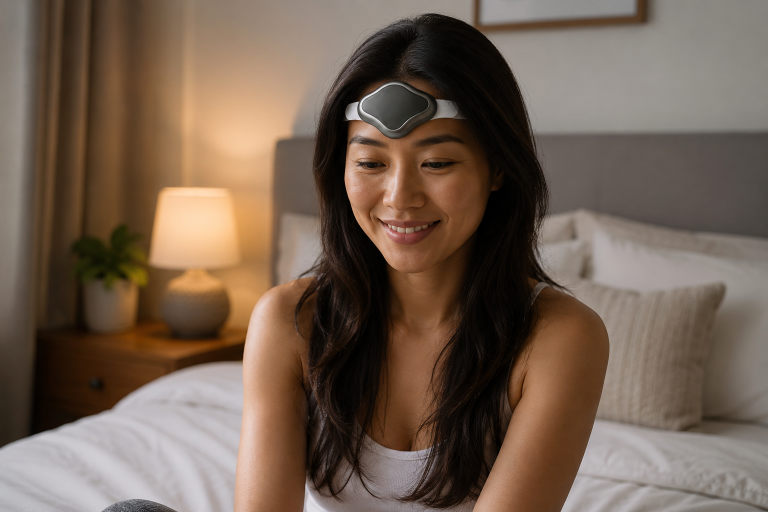
Cefaly targets the trigeminal nerve, a major pathway involved in migraine pain. The device delivers precise electrical impulses through an electrode placed on the forehead, between and just above the eyebrows. These impulses stimulate the supraorbital and supratrochlear branches of the trigeminal nerve.
The mechanism of action differs from sumatriptan’s serotonin-receptor activity and vasoconstrictive effects. Cefaly uses two programs for different treatment goals:
Acute Program
- One 60-minute session
- Used at the earliest sign of a migraine attack
- Activated by pressing the device button once
- Uses a turquoise or aqua indicator light
Prevent Program
- One 20-minute session each day
- Intended to reduce migraine frequency over time
- Activated by pressing the device button twice
- Uses a purple indicator light
Consistent Prevent use is designed to make the trigeminal nerve less reactive to migraine triggers over time. Results vary, and prevention should be evaluated over an appropriate treatment period with a healthcare provider when needed.
Clinical Evidence for Cefaly
Cefaly’s clinical trials include more than 20 years of research, more than 12 clinical trials, 18 peer-reviewed publications, and three pivotal prospective, multicenter, sham-controlled randomized trials.
ACME Study: Acute Treatment
The ACME study evaluated one hour of Cefaly Acute treatment during a migraine attack.
- 79% of patients experienced a significant reduction in headache pain after one hour.
- 63% reported that pain decreased by at least half after one hour.
TEAM Study: Acute Treatment
The TEAM study evaluated acute e-TNS treatment and migraine-associated symptoms.
- 56.4% of patients reported resolution of their most bothersome migraine-associated symptom after two hours.
- 67.3% of patients who identified nausea as their most bothersome symptom reported that it resolved.
- 42.5% reported resolution of all migraine symptoms after two hours.
PREMICE Study: Prevention
The PREMICE study evaluated daily preventive treatment in adults with episodic migraine.
- 38.1% of participants achieved at least a 50% reduction in migraine days.
- Monthly headache days decreased by an average of 32.7% after three months of compliant Prevent treatment.
- Acute migraine medication intake decreased by an average of 36.6% across participants.
- Among participants who responded to Prevent treatment, acute medication intake decreased by 74.4%.
The medication-use findings are group-level study outcomes. They do not establish that Cefaly prevents, reduces, or treats medication-overuse headache. The current user manual states that safety and effectiveness have not been demonstrated for people with medication-overuse headache.
The International Headache Society’s 2025 evidence-based neuromodulation guidelines include conditional recommendations for e-TNS in acute and preventive migraine treatment. Individual suitability and response should still guide treatment decisions.
Cefaly Safety Profile
Cefaly clinical studies reported no serious adverse effects associated with treatment. The current user manual describes reported effects as generally minor and reversible after device use stops.
Reported side effects include:
- Sleepiness during treatment, reported by approximately 0.5% of study participants
- Headache after a Prevent session, reported by approximately 0.5%
- Discomfort or pain during stimulation
- Temporary forehead redness, reported by approximately 0.2% and usually resolving within 15 minutes
- Rare nausea during an Acute session
- Persistent tingling or other stimulation sensations after a session
- Neck discomfort related to muscle tension or treatment posture
- Rare forehead skin allergy
Cefaly avoids systemic medication exposure and drug-drug interactions, but it is not free of contraindications or precautions.
Cefaly Contraindications
Do not use Cefaly if you have any contraindication identified in the current user manual, including:
- An implanted metallic or electronic device in the head
- Pain of unknown origin
- A cardiac pacemaker or implanted or wearable defibrillator
- Recent brain or facial trauma
- A forehead abrasion where the electrode would be applied
- Acrylate allergy
- Cutaneous hypersensitivity that prevents tolerating stimulation
- Trigeminal neuralgia
- Ophthalmic shingles
Ask a doctor before use when relevant, including if you are pregnant or may become pregnant, have known or suspected heart problems, have a seizure history, recently experienced a head injury, have never received a migraine diagnosis, or are experiencing a new, unusual, or severe headache.
The manual also advises consulting a healthcare provider before use if you have medication-overuse headache, chronic tension-type headache, or refractory migraine because safety and effectiveness have not been demonstrated for these conditions.
Using Cefaly Correctly
Proper preparation and electrode placement help support consistent treatment.
Electrode Placement
The electrode is centered on the forehead between and just above the eyebrows. The device attaches magnetically to the electrode.
Skin Preparation
- Wash the forehead with basic soap and water.
- Dry the skin completely before applying the electrode.
- Avoid applying the electrode over damaged, irritated, inflamed, or unclean skin.
Treatment Comfort
- Use Cefaly while sitting or reclining with the head tilted back.
- Stimulation intensity gradually increases during the first 14 minutes.
- Briefly press the device button during this period to stabilize the intensity at a comfortable level.
- Stimulation may feel like tingling, vibration, pressure, or pulsing. It should remain within a tolerable range.
Electrode Care
Cefaly offers standard and hypoallergenic electrodes. Electrode life varies according to skin preparation, storage, and treatment conditions. Replace an electrode when it no longer adheres securely or delivers consistent stimulation. An optional subscription program provides scheduled electrode delivery.
Cefaly App and Support Resources
Where available, the Cefaly mobile application can pair with Cefaly Connected through Bluetooth. It supports:
- Acute and Prevent program control
- Real-time intensity adjustment and session monitoring
- Migraine, symptom, trigger, and treatment logging
- Wearable-data integration
- Weather and barometric-pressure tracking
- Personalized reports for healthcare-provider discussions
The Cefaly Migraine Relief app, Cefaly Connected device, and coaching services are not currently available in the European Union.
Additional support resources include a free personal coach, a network of certified providers, and customer support for setup and device questions. Availability can vary by region.
Can Cefaly and Sumatriptan Be Used Together?
Cefaly can be used alongside existing migraine treatments without drug-drug interactions because it does not deliver medication. Some treatment plans may use Cefaly Prevent daily, Cefaly Acute during attacks, and a prescribed acute medication when needed.
This does not mean every combination is appropriate for every person. Do not reduce, discontinue, delay, or change prescribed migraine medication without consulting the healthcare provider responsible for your treatment.
Using Cefaly does not guarantee reduced triptan use or protection from medication-overuse headache. The PREMICE study documented lower average acute medication intake among participants, but individual results vary.
Cost and Access Considerations
Cefaly Connected is currently listed at $509 in the United States. Replacement electrodes are an ongoing expense. Cefaly estimates approximately $350 to $450 per year for electrodes, depending on treatment frequency, electrode type, care, and storage.
Actual costs compared with sumatriptan vary according to:
- Insurance coverage and copays
- Pharmacy pricing
- Sumatriptan formulation and number of doses used
- Frequency of healthcare visits
- Cefaly treatment frequency
- Electrode type and replacement schedule
Cefaly’s reusable ownership model may offer practical value for people who use both acute and preventive treatment regularly, but it should not be presented as universally less expensive than medication.
Cefaly devices and electrodes are listed as eligible health savings expenses, subject to HSA or FSA plan requirements. Products purchased directly from cefaly.com are also covered by a 90-day satisfaction guarantee under the current return policy.
Choosing Between Sumatriptan and Cefaly
The strongest reason to choose Cefaly is its combination of acute and preventive treatment in one drug-free, prescription-free device. Sumatriptan remains an established prescription option for acute migraine treatment, but it does not provide prevention and may be unsuitable for people with specific cardiovascular, cerebrovascular, vascular, hepatic, or drug-interaction concerns.
Cefaly may be especially worth discussing when you:
- Want both acute and preventive treatment in one device
- Prefer to avoid systemic medication exposure
- Experience unwanted effects from acute medications
- Take multiple medications and want to avoid another drug interaction
- Have a condition or risk factor that complicates triptan use
- Want a prescription-free, reusable treatment option
Sumatriptan may remain appropriate when a healthcare provider determines that a triptan is safe and an acute prescription medication fits the patient’s attack pattern and treatment goals.
Migraine treatment is individualized. A healthcare provider can help determine whether Cefaly, sumatriptan, another medication, another neuromodulation device, or a combined plan is appropriate.
Frequently Asked Questions
What is the main difference between Cefaly and sumatriptan?
Sumatriptan is a prescription medication used for acute migraine treatment. Cefaly is a drug-free e-TNS device that provides both a 60-minute Acute program and a 20-minute daily Prevent program. Cefaly therefore supports a broader treatment role while avoiding systemic medication exposure and drug-drug interactions.
Does Cefaly work faster than sumatriptan?
The two treatments have different formats and should not be compared through an unsupported head-to-head speed claim. Cefaly Acute is a 60-minute treatment program. Sumatriptan onset varies by formulation, dose, and patient response, with injectable products generally acting faster than oral products.
Can Cefaly reduce medication use?
In the PREMICE study, participants reduced acute migraine medication intake by an average of 36.6% after three months of Prevent treatment. This was a group-level outcome and does not guarantee that an individual will reduce medication use. Do not change prescribed medication without consulting a healthcare provider.
Does Cefaly prevent medication-overuse headache?
No clinical claim should state that Cefaly prevents or treats medication-overuse headache. The Cefaly user manual says safety and effectiveness have not been demonstrated in people with medication-overuse headache and advises consulting a healthcare provider before use.
Is Cefaly available without a prescription?
Yes. Cefaly is available without a prescription in the United States, Canada, the European Union, and other countries. Regional product versions and support services may differ. Cefaly Connected, the app, and coaching services are not currently available in the EU.
What are Cefaly’s most important safety considerations?
Cefaly is drug-free, and its reported clinical-study effects were generally minor and reversible, but users must follow the current contraindications and warnings. These include restrictions involving implanted head devices, pacemakers, defibrillators, recent brain or facial trauma, certain skin conditions, acrylate allergy, trigeminal neuralgia, ophthalmic shingles, and other circumstances described in the user manual.
Who may benefit most from Cefaly?
Cefaly may be particularly useful for adults seeking both acute and preventive treatment, a drug-free option, prescription-free access, or a way to avoid systemic medication exposure and drug-drug interactions. A healthcare provider should assess whether the device is appropriate for anyone with a complex medical history or unusual headache symptoms.






Latest Posts

The Essential Guide To Medical Devices For Migraine
CEFALY is an FDA-cleared medical device that targets the main pathway for migraine pain: the trigeminal nerve (the…
Best Forehead Migraine Device in 2026
Migraine affects more than 40 million people in the United States. For adults who want a non-invasive option…

Best e-TNS Migraine Device in 2026
Migraine is a neurological disease that can affect work, sleep, family life, and daily routines. For people who…